Takeaways from MTLC’s Tech Hot Topic
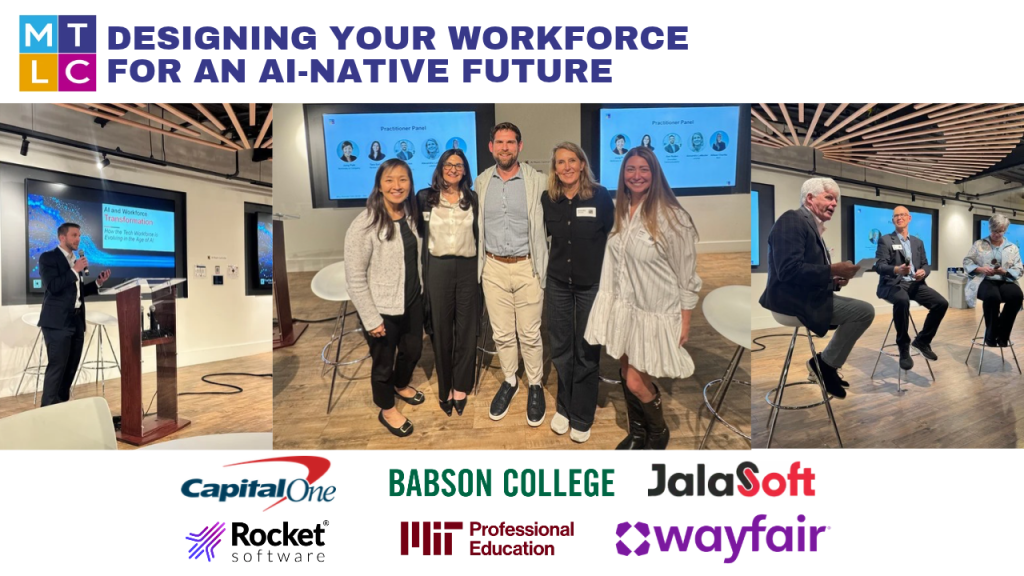
As AI continues to transform how work gets done, technology leaders are being challenged to think beyond automation and begin redesigning the very nature of work itself. At MTLC’s recent Tech Hot Topic: Workforce event, executives, HR leaders, and workforce strategists came together to discuss what it means to build organizations that can thrive in an AI-enabled future.
A special thank you to our speakers and panelists, including Will Markow (FourOne Insights), Tom Davenport (Babson College), Mike Beck (Nasuni), Sharon Gadonniex (Capital One), Jung Paik (McKinsey & Company), Tara Gallone (Rocket Software), Allison Churilla (Bevi), Alexandra LaMaster (Jellyfish), and Ken Roden (Diversified Communications), as well as our host, Wayfair, for bringing together such a thoughtful and timely discussion.
Here are some of the biggest themes that emerged throughout the morning.
AI May Be Breaking the Corporate Apprenticeship Model
One of the most thought-provoking discussions centered on a question many organizations haven’t fully answered yet: if AI takes over entry-level work, where will the next generation gain experience?
Will Markow shared data showing a sharp decline in entry-level technology hiring, raising concerns about the long-term impact on talent development. Many of the tasks now being automated have historically served as critical training grounds for early-career employees, helping them develop business context, judgment, communication skills, and technical expertise.
Organizations have spent decades building talent pipelines around learning by doing. As AI changes what that “doing” looks like, companies may need to rethink how they develop future managers, technical leaders, and executives.
Human Judgment Is Becoming a Premium Skill
For all the attention AI receives, speakers repeatedly returned to the value of uniquely human capabilities.
Critical thinking, problem-solving, adaptability, communication, and decision-making surfaced again and again as skills organizations are prioritizing. As AI makes it easier to generate content, insights, code, and recommendations, the challenge shifts from producing information to evaluating it.
In many cases, the competitive advantage won’t come from having access to better tools. It will come from having people who know how to ask better questions, challenge assumptions, and exercise sound judgment when the answers aren’t obvious.
The Companies Winning with AI Are Redesigning Workflows, Not Just Tasks
A common mistake in AI adoption is using technology to accelerate existing processes without reconsidering whether those processes still make sense.
Several panelists described a different approach: stepping back and examining work itself.
Rather than focusing solely on individual jobs or tasks, organizations are looking at end-to-end workflows and determining where AI can remove friction, support decision-making, and create better outcomes. The most successful implementations aren’t simply helping employees do the same work faster. They’re prompting leaders to rethink how work gets done in the first place.
That distinction may ultimately separate organizations that deploy AI from those that truly transform with it.
Stop Measuring AI Usage. Start Measuring Outcomes.
A particularly compelling theme from the practitioner panel was the need to move beyond adoption metrics.
Tracking licenses, prompt counts, or usage rates can help leaders understand whether tools are being utilized, but those measures don’t necessarily indicate value.
What matters is whether AI is improving customer experiences, accelerating decision-making, shortening sales cycles, increasing productivity, reducing friction, or creating measurable business impact.
As organizations mature in their AI journeys, the conversation is shifting away from “How many people are using AI?” and toward “What changed because they used it?”
AI Can Make Employees Faster. It Can Also Make Managers the Bottleneck.
Most discussions about AI focus on individual productivity gains. Less attention has been paid to what happens when everyone suddenly produces more.
As teams generate more ideas, analyses, content, and recommendations, managers often become responsible for reviewing, validating, prioritizing, and acting on a much larger volume of work. In some cases, AI doesn’t eliminate bottlenecks. It simply moves them.
That reality is making leadership more complex. Success increasingly depends on helping teams distinguish between activity and impact, determining where human oversight matters most, and ensuring that faster output ultimately translates into better outcomes.
Continuing the Conversation
As organizations move beyond experimentation, leaders are being asked to make decisions about workforce design, skills development, hiring, management, and organizational structure in a rapidly changing environment. The companies that gain an advantage won’t necessarily be those with access to the best tools. They’ll be the ones that most effectively rethink how work gets done and how people contribute alongside increasingly capable technologies.
Those questions will continue to evolve, and so will the conversations. We hope you’ll join us on December 4 for the next installment of MTLC’s Tech Hot Topic Series, where we’ll turn our attention to another challenge at the top of every executive agenda: Cybersecurity. We hope to see you there.